
Li-Polymer vs 18650 vs 21700: The Definitive B2B Battery Cell Selection Guide for Portable Electronics
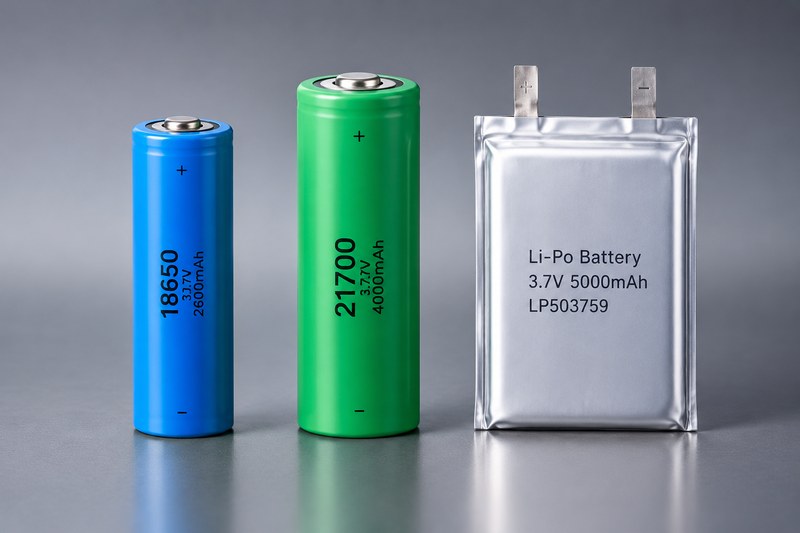
Executive Summary & Direct Answer
For B2B electronics importers, OEM brand managers, and product engineers, choosing the right lithium battery cell architecture dictates product dimensions, thermal dissipation, cycle durability, regulatory compliance, and total landed cost.
- Specify Lithium Polymer (Li-Po pouch cells) when designing ultra-slim consumer devices (<15mm thickness), curved housings, lightweight magnetic power banks, or custom-molded industrial electronics.
- Specify 18650 cylindrical cells for cost-sensitive standard enclosures, rugged outdoor gear, high-impact industrial tools, and mid-tier promotional power banks where steel-can mechanical protection is paramount.
- Specify 21700 cylindrical cells for high-power USB-C Power Delivery (>65W–140W), laptop power stations, and compact ultra-high-capacity devices (>20,000mAh) demanding maximum gravimetric energy density ($Wh/kg$) and superior high-C discharge rates.
1. Engineering Comparison Matrix: Li-Polymer vs 18650 vs 21700
The table below provides direct engineering benchmarks measured across tier-1 manufacturing runs at Shenzhen Casun Technologies Co., Ltd. (深圳市昌昊科技有限公司), accounting for standardized 3.7V nominal lithium-ion chemistries:
| Parameter | Lithium Polymer (Li-Po) | 18650 Cylindrical | 21700 Cylindrical |
|---|---|---|---|
| Standard Form Factor | Pouch cell (Variable H×W×L) | Φ18mm × 65mm cylinder | Φ21mm × 70mm cylinder |
| Casing Material | Aluminum-laminated foil film | Nickel-plated steel can | Nickel-plated steel can |
| Gravimetric Energy Density | 180 – 240 Wh/kg | 200 – 250 Wh/kg | 240 – 300 Wh/kg |
| Volumetric Efficiency | High (fills square/flat enclosures) | Medium (cylindrical packing voids) | High (lower void ratio per Wh) |
| Continuous Discharge Rate | 1C – 3C (standard) | 1C – 5C (high-drain variants) | 3C – 10C (power series) |
| Cycle Life (80% Capacity DoD) | 500 – 800 cycles (Grade A) | 500 – 1,000 cycles | 800 – 1,200 cycles |
| Swelling / Gas Margin Need | 8% – 12% expansion space required | None (rigid container) | None (rigid container) |
| Built-in Mechanical Safety | Foil seams rupture before explosion | CID vent + PTC thermal resistor | CID vent + Explosion-proof valve |
| Relative Cost per Watt-Hour | Base ($1.00x) | Economical ($0.82x – $0.90x) | Premium ($1.08x – $1.20x) |
2. Architectural Deep-Dive: Mechanical & Electrical Trade-Offs
A. Lithium Polymer (Pouch Cells): The King of Industrial Design Flexibility
Lithium Polymer pouch cells utilize stacked or z-folded cathode/anode layers encapsulated in an aluminum-laminated composite film. Because there is no rigid steel cylinder, pouch cells achieve superior packaging efficiency in rectangular profiles.
- Form Factor Versatility: Pouch cells can be manufactured in virtually any thickness (from 3.0mm up to 14.0mm) and custom footprint. This makes them the only viable choice for smartphone-backed magnetic wireless chargers, slim power banks (<12mm), smart eyewear batteries, and TWS charging cases.
- Structural Swelling Protocol: Over continuous charge-discharge cycles, pouch cells generate trace electrolyte decomposition gases. Factory engineering guidelines at Casun mandate an intentional 8% to 10% volumetric expansion clearance inside injection-molded enclosures to prevent screen delamination or chassis cracking over 300+ cycles.
B. 18650 Cylindrical Cells: Mature, Standardized, and Mechanically Robust
The 18650 cell (Φ18mm × 65mm) remains the most standardized mass-production lithium cell in the electronics industry. Featuring an automated cylindrical jelly-roll design housed in a nickel-plated steel casing, 18650 cells provide inherent crush resistance.
- Integrated Safety Mechanisms: Industrial 18650 cells feature a top-cap assembly containing a Current Interrupt Device (CID) that mechanically disconnects the circuit when internal gas pressure exceeds 1.0–1.2 MPa, alongside a Positive Temperature Coefficient (PTC) element that suppresses short-circuit current surges.
- Enclosure Limitation: Because the minimum diameter is fixed at 18.0mm (typically requiring 20.0mm–22.0mm external case thickness once PC+ABS wall thickness and shock pads are added), 18650s cannot be used in modern pocket-slim power banks.
C. 21700 Cylindrical Cells: The High-Power Density Standard for 65W–140W PD
Originally popularized by electric vehicle (EV) drivetrains, the 21700 cell (Φ21mm × 70mm) provides approximately 46% to 50% more internal volume than an 18650, while delivering up to 100% greater energy capacity per cell (4,800mAh–5,000mAh vs 2,500mAh–3,000mAh).
- High-C Discharge Capability: For high-wattage USB-C Power Delivery (PD 3.0 / PD 3.1) power banks delivering 65W, 100W, or 140W to laptops, 21700 cells maintain thermal stability under continuous 5A to 15A discharge loads without triggering aggressive BMS thermal throttling.
- Reduced Interconnect Resistance: Building a 20,000mAh pack with four 21700 cells (4×5000mAh in 4S1P or 2S2P) requires significantly fewer nickel spot welds and busbars than using eight 18650 cells (8×2500mAh), reducing overall internal resistance ($R_{int}$) and thermal loss ($P = I^2R$).
3. The B2B Sourcing Hazard: Grade A vs Grade B vs Recycled Cells
The single largest source of pricing divergence in supplier quotes across Shenzhen and Dongguan is battery cell grading. Two power banks with identical exterior tooling and identical printed "10,000mAh" ratings can differ in cell cost by over 100% to 180%.
Factory Warning: The 3 Tiers of Lithium Cells in the Supply Chain
- Brand-New Grade A Cells (Casun Standard): Direct tier-1 procurement from authorized manufacturers (ATL, Lishen, BAK, EVE, Samsung SDI). High purity cathode materials, factory-matched internal impedance ($\Delta IR \le 2\,m\Omega$), tight capacity consistency ($\Delta C \le 1\%$), and verified cycle life (≥80% capacity retention after 500–800 full cycles).
- Grade B / Factory Overstock Cells: Cells that failed primary optical or impedance binning at tier-1 factories, or aged inventory stored past shelf-life without maintenance voltage. Characterized by elevated internal resistance (>35–50 $m\Omega$), self-discharge exceeding 3% per month, and premature capacity collapse within 100–150 cycles.
- Second-Life / Re-sleeved EV Dismantled Cells (Extreme Hazard): Salvaged cells recovered from scrapped e-bike or EV packs, chemically cleaned, re-sleeved with new PVC labels, and spot-welded into low-end consumer power banks. These cells present severe dendrite formation risks, internal micro-shorts, and catastrophic thermal runaway under fast-charging conditions.
4. 4-Step Factory Verification Protocol for B2B Incoming Inspection
To ensure zero defect escapes and safeguard international brand equity, Shenzhen Casun Technologies operates an incoming quality control (IQC) protocol across all battery cell batches before SMT assembly:
AC Internal Resistance Matching
1kHz AC Milliohm Meter testing (Hioki 3561 standard). Every cell entering production must match within ±1.5 $m\Omega$ of batch median to prevent circulating eddy currents in multi-cell parallel configurations.
0.2C – 1.0C Capacity Grading
100% automated charge-discharge cabinet cycling across 5 channels: 0.2C standard discharge check, 1.0C continuous load stress test, and cut-off voltage retention validation at 2.75V / 4.20V / 4.35V thresholds.
High-Temperature Storage & Swelling
Environmental chamber aging at 45°C ± 2°C for 72 hours under 100% State of Charge (SOC). Dimensional calipers verify thickness expansion remains strictly ≤2.5% of nominal uncharged baseline.
Batch Traceability & Laser Code
Optical matrix scanning of raw manufacturer 2D QR codes to verify factory lot origin, electrode slurry batch date, and prevent unauthorized vendor substitution.
5. International Compliance: Mandated Certifications by Market
Exporting lithium-powered electronics requires navigating country-specific safety directives and transport classifications. Never ship commercial quantities without verifying the following certified test reports:
| Destination Market | Mandatory Certification | Governing Standard | Key Test Criteria |
|---|---|---|---|
| Global Transport (Air / Sea) | UN 38.3 + MSDS | UN Manual of Tests (ST/SG/AC.10/11) | Altitude simulation (T1), Thermal test (T2), Vibration (T3), Shock (T4), External short circuit (T5), Impact/Crush (T6), Overcharge (T7), Forced discharge (T8). |
| European Union (EU / UK) | CE-LVD + CB + RoHS | EN 62368-1 / IEC 62133-2:2017 | Continuous charging safety, case stress relief at 70°C, thermal abuse, mechanical drop test, WEEE environmental recycling compliance. |
| United States (USA / Canada) | UL 2056 / UL 1642 / FCC | ANSI/CAN/UL 2056 / FCC Part 15B | Overcharge/overcurrent shutdown, component temperature limits under maximum load, flammability rating (UL94 V-0 enclosure), radiated EMC emissions. |
| Japan | PSE (Circle / Diamond) | DENAN Act Ordinance Appendix 9 | Volumetric energy density (≥400 Wh/L trigger threshold), nail penetration safety, drop resistance onto concrete from 1.0m. |
| South Korea | KC Safety Certification | KC 62133-2 | Mandatory factory audit inspection, cell registration, and EMC compliance testing at accredited Korean test labs (KTL/KTC). |
6. Actionable RFQ Specification Clause for B2B Purchase Contracts
When issuing RFQs or Purchase Agreements to Chinese manufacturers, paste the following clause into your technical requirements to legally bind suppliers to authentic Grade A cell quality:
1. Cell Grade & Origin: All battery cells utilized in mass production shall be 100% brand-new Grade A cells sourced directly from certified tier-1 manufacturers (ATL, Lishen, BAK, EVE, or agreed equivalent). Use of Grade B, B-bin, surplus stock, re-conditioned, or recycled cells is strictly prohibited and constitutes a material breach of contract.
2. Impedance & Capacity Consistency: Incoming cell internal resistance (AC 1kHz) shall not exceed [insert: e.g., 25mΩ for Li-Po / 18mΩ for 21700], with batch variance ΔIR ≤ 2.0mΩ. Measured 0.2C discharge capacity shall be ≥ 100% of nominal rating.
3. Cycle Durability: The assembled pack must retain ≥ 80.0% of rated capacity after 500 complete charge-discharge cycles under standard ambient conditions (25°C ± 2°C, 0.5C charge / 1.0C discharge).
4. Safety & Protection Circuitry: Dual independent IC hardware protection must be implemented on the PCB, encompassing Over-Voltage Protection (OVP ≤ 4.28V ± 0.025V), Under-Voltage Protection (UVP ≥ 2.50V ± 0.05V), Over-Current Protection (OCP), and NTC thermal cut-off at 55°C charge / 65°C discharge.
5. Inspection Rights: Buyer reserves the right to conduct unannounced on-site batch sampling and teardown analysis prior to final ex-factory shipment.
7. Frequently Asked Questions (FAQ)
Q1: Why is a 21700 power bank more compact than an 18650 power bank of the same capacity?
A 10,000mAh power bank built with 21700 cells requires only two cells (2 × 5,000mAh), whereas an 18650 design requires four cells (4 × 2,500mAh). Two 21700 cells occupy approximately 48.5 $cm^3$ of raw cell volume compared to 66.1 $cm^3$ for four 18650 cells, eliminating two internal packaging voids and reducing total casing weight by ~25%.
Q2: What causes lithium polymer pouch cells to swell after 6–12 months of use?
Pouch cell swelling is primarily driven by three factors: (1) low-grade electrolyte formulation with moisture contamination during factory winding, (2) prolonged exposure to elevated temperatures (>45°C) during fast charging, and (3) BMS over-charging above 4.35V or severe over-discharging below 2.4V. Using certified Grade-A cells with high-precision Seiko/Richtek BMS protection ICs effectively eliminates abnormal swelling.
Q3: How does Shenzhen Casun Technologies ensure battery compliance for export to North America and Europe?
As an ISO 9001:2015, amfori BSCI, and Sedex SMETA audited manufacturing facility with 5 automated production lines and 1,800 m² of cleanroom assembly, Casun (深圳市昌昊科技有限公司) maintains complete UN 38.3, IEC 62133-2, CE, FCC, RoHS, and UL 2056 test certificates across our OEM/ODM product catalog. Every production batch undergoes 100% aging testing and computerized impedance logging before dispatch.
Partner with an Audited OEM Power Bank & Portable Electronics Manufacturer
Looking for reliable, certified OEM/ODM manufacturing for magnetic power banks, high-wattage PD chargers, or smart audio electronics with guaranteed Grade A battery cells?